您准备好探索海洋洞察力如何帮助您解锁未知数?亚博最新网站多少
Our world-class experts are available to help find answers to your toughest questions.

需要更多地了解我们的纤维如何工作及其特性?我们已经编辑了一些有用的信息,以节省您的时间,并确保您为应用程序选择正确的纤维类型。
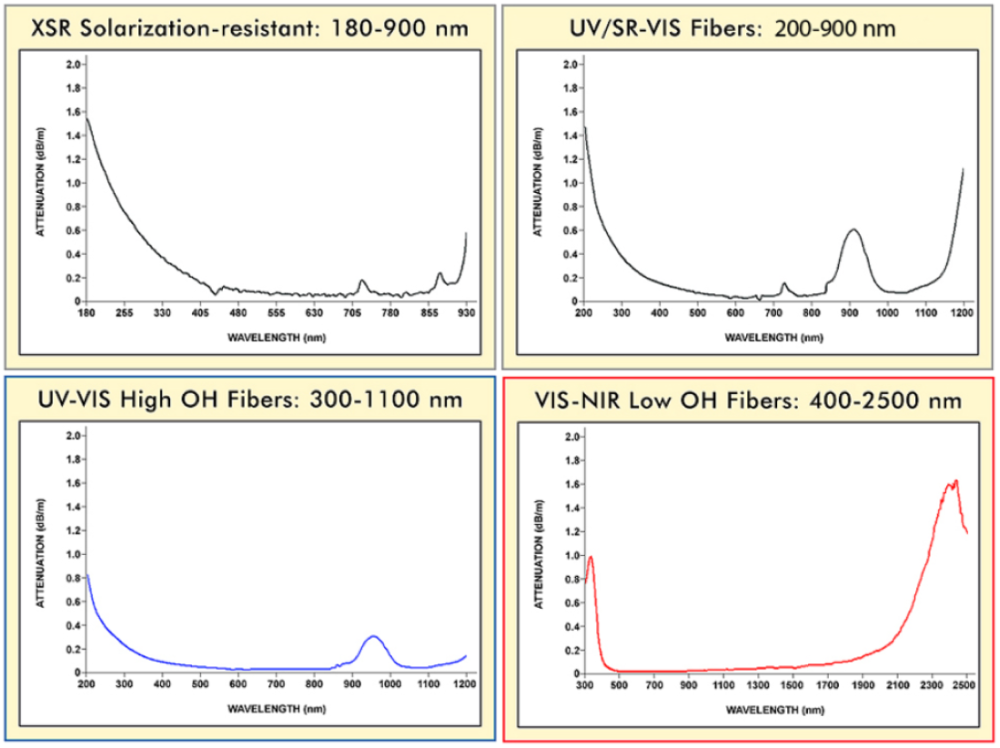
To achieve the best system performance, it is important to choose optical fibers that transmit well over your full wavelength range of interest. This will minimize the amount of light lost through fiber coupling, and reduce attenuation of some wavelengths over others. When working in the ultraviolet portion of the spectrum, particularly below 300 nm, it is important to use solarization-resistant fibers, as other fibers will become less transmissive over time at those wavelengths (an effect known as solarization).
在下面查看以找到最适合您应用程序的衰减频谱,或与我们的一名应用工程师联系以获取指导。请记住,1 dB相当于传输中损失的〜21%的光。
我们的光纤和探针组件以三种方式清晰清晰地标记,以便您始终确定零件数,纤维核直径及其最佳效率波长范围。
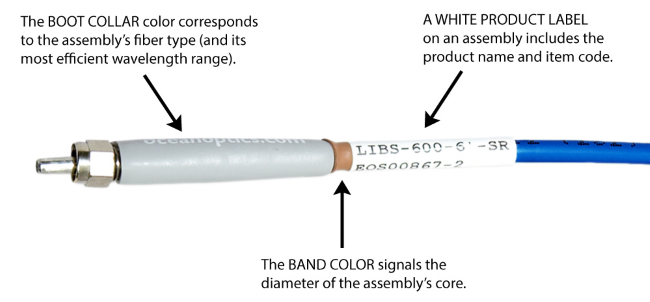
The assembly’s boot color lets you know the fiber type and the most efficient wavelength range for using your fiber.
| Boot | 颜色 | 产品代码 | Fiber Type | Best Efficiency |
 |
灰色的 | -XSR | UV-VIS XSR Solarization Resistant | 180 – 800 nm |
|
灰色的 | -SR | UV/SR-VIS High OH content | 200– 1100 nm |
 |
蓝色的 | -UV-VIS | UV-VIS高哦内容 | 300 - 1100 nm |
 |
红色的 | -vis-nir | Vis-nir低OH内容 | 400 - 2100 nm |
The assembly’s color band tells you the the fiber core diameter.
| 乐队 | 颜色 | 纤维核心大小 |
| 紫色的 | 8 μm | |
| 蓝色的 | 50μm | |
| Green | 100μm | |
| Yellow | 200μm | |
| 灰色的 | 300μm | |
| 红色的 | 400 μm | |
| Orange | 500μm | |
| 棕色的 | 600 μm | |
| Clear | 1000μm |
纤维组件外套旨在保护纤维并提供应变缓解,但我们有可以做更多的选择。告诉我们有关将使用光纤组件的环境和应用,我们将帮助您选择用于组件的最佳夹克材料。
| Jacket | Description | Outer Diameter | 耐化学性 | 蒸汽无菌 | 温度限制 | 机械耐受性 | Maximum Length |
| PVC monocoil | PVC覆盖不锈钢单镜;仅OEM申请 | 3.4毫米 | 较差的 | No | 70°C | Good | 6 m |
| PVDF拉链管 | Best for budget-conscious applications; standard in lab-grade assemblies | 3.8毫米 | 较差的 | No | 100°C | Good | 50公尺 |
| PVDF拉链管(大OD) | Best for budget-conscious applications; larger in diameter than jacket #2 | 5.0毫米 | 较差的 | No | 100°C | Good | 50公尺 |
| Silicone Monocoil | 高端外套;高级组件的标准(覆盖不锈钢单镜的硅树脂) | 5.6毫米 | Good | 是的 | 250°C | Good | 20m |
| 不锈钢BX | 仅OEM申请;可选的聚烯烃热丝网大衣 | 5.0毫米 | Good | 是的 | 250°C | 较差的 | 4 m |
| 不锈钢完全互锁的BX | Excellent stainless steel jacketing; supports longer lengths of fiber; optional polyolefin heatshrink overcoat | 7.0毫米 | Good | 是的 | 250°C | Excellent | 40 m |
Optical fiber works by guiding light down the fiber core due to variations in index of refraction between the core and cladding. A flexible buffer material in one or more layers is then applied to improve flexibility and protect the glass core/cladding. Even with this additional coating, there are still limits on how tightly the fiber can be bent without being prone to microscopic fractures that can lead to breaks.
LTBR(长期弯曲半径):观察为存储条件的最小半径。
STBR(短期弯曲半径):使用和处理过程中允许的最小半径。
| 乐队 | 纤维核心大小 | 纤维类型 | Cladding Thickness | 缓冲材料 | Buffer Thickness | Maximum OD | Operating Temperature (fiber core) | LTBR | stbr |
| 50±5μm | VIS/NIR,UV/VIS | 35±0.5 µm | 聚酰亚胺 | 17±5 µm | 155 µm | -65至300°C | 4 cm | 2cm | |
| 100± 3 μm | VIS/NIR,UV/VIS | 12±5 µm | 聚酰亚胺 | 17 ± 3 µm | 155 µm | -65至300°C | 4 cm | 2cm | |
| 200± 4 μm | VIS/NIR,UV/VIS, SR | 10± 4 µm | 聚酰亚胺 | 10±5 µm | 243 µm | -65至300°C | 8 cm | 4 cm | |
| 300 ± 6 μm | Sr | 15 ± 7 µm | 聚酰亚胺 | 20±10 µm | 380 µm | -65至300°C | 12厘米 | 6厘米 | |
| 400 ± 8 μm | VIS/NIR,UV/VIS, SR | 20± 3 µm | 聚酰亚胺 | 20± 7 µm | 487 µm | -65至300°C | 16厘米 | 8 cm | |
| 500 ± 10 µm | VIS/NIR,UV/VIS | 25±3 µm | 聚酰亚胺 | 20±10 µm | 600 µm | -65至300°C | 20cm | 10厘米 | |
| 600 ± 10 μm | VIS/NIR,UV/VIS, SR | 30±3 µm | 聚酰亚胺 | 25 ± 10 µm | 720 µm | -65至300°C | 24 cm | 12厘米 | |
| 1000± 3 µm | VIS/NIR | 50 ± 3 µm | 丙烯酸酯 | 50 ± 40 µm | 1120µm | -50至85°C | 30 cm | 15 cm | |
| 1000± 20 µm | 紫外线/vis | 25±3 µm | 丙烯酸酯 | 50 ± 40 µm | 1065 µm | -50至85°C | 30 cm | 15 cm | |
| VIS/NIR is multimode step index fiber with a low OH fused silica core and glass cladding (400 – 2100 nm) UV/VIS是多模阶段索引纤维,具有高OH熔融二氧化硅芯和玻璃覆层(300 - 1100 nm) Sris multimode step index fiber with a high OH fused silica core and glass cladding (200 – 1100 nm) |
|||||||||
| 乐队 | 纤维核心大小 | 纤维类型 | 覆层OD | 缓冲材料s | Primary Buffer OD | Maximum OD | Operating Temperature (fiber core) | LTBR | stbr |
| 113±6μm(名义115μm) | XSR | 125±6 µm | aluminum, polymer | 150 µm | 230 µm | -50至80°C | 4 cm | 2cm | |
| 230 ± 12 μm | XSR | 250 ± 13 µm | aluminum, polymer | 300 µm | 380 ± 20 µm | -50至80°C | 4 cm | 2cm | |
| 455 ± 22 μm | XSR | 500±25 µm | 铝,硅胶,尼龙 | 580 µm | 1300 ± 100 µm | -50至80°C | 8 cm | 4 cm | |
| 600±30μm | XSR | 660±33 µm | 铝,硅胶,尼龙 | 800 µm | 1700±200 µm | -50至80°C | 24 cm | 12厘米 | |
| XSRis multimode step index fiber with a high OH fused silica core and fluorine-doped silica cladding (180 – 900 nm) | |||||||||
| 乐队 | 纤维核心大小 | 纤维类型 | 覆层OD | 缓冲材料 | 缓冲区OD | Operating Temperature (fiber core) | LTBR | stbr |
| 8.2 ± 0.2 μm | 单模式 | 125 ± 7 µm | dual acrylate | 245±5 µm | -60至85°C | 4 cm | 2cm | |
| 单模式fiber is Corning SMF-28e+ fiber optimized for telecom use (1260 – 1700 nm) Single-mode performance ceases below the cutoff wavelength of λc = 1260 nm |
||||||||
光纤旨在将光从纤维的一端传输到另一端,而能量损失最小。光纤中的操作原理是总内部反射。当光从一种材料传递到另一种材料时,其方向就会改变。根据Snell的定律,可以从两种材料的折射率中预测光射线的新角度。当角度垂直于界面(90º)时,向第二材料的传输是最大的,并且反射为最小。随着角度接近界面的平行,反射会增加。在临界角度和临界角度以下,传输为0%,反射为100%(请参见下图)。
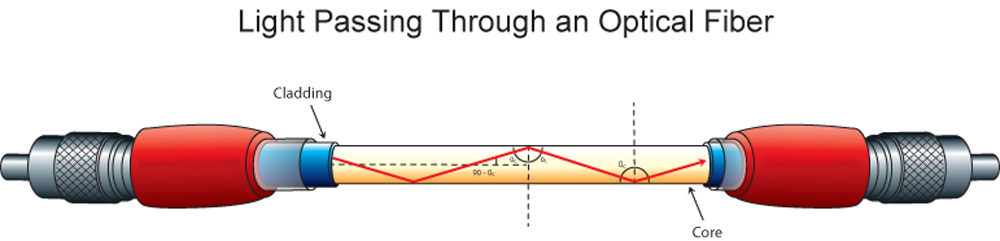
Snell’s Law can be formulated to predict critical angle and also the launch or exit angle θmax从核心折射索引(n1)和覆层(n2)materials. The angle also depends on the refractive index of the media (n)。

The left side of equation is called the numerical aperture (NA),并确定纤维可以接受或发出光的角度范围。
大多数海洋亚博最新网站多少洞察纤维的数值光圈为0.22(请参见下表)。如果纤维在真空或空气中,则转化为接受角度θmax12.7°(全角度〜25o)。当光在光纤的末端定向时,所有的光线或轨迹都在±12.7°圆锥内部以内的光线或轨迹通过总内部反射传播纤维的长度。超过该角度的所有光线都穿过覆层并丢失。在纤维的另一端,光在±12.7°的锥体中退出。
There are many types of fibers available, with a variety of numerical apertures. While a fiber with a larger numerical aperture will collect more light than a fiber with a smaller numerical aperture, it is important to look at both ends of the system to ensure that light exiting at a higher angle can be used. In optical sensing, one end is gathering light from an experiment and the other is directing light to a detector. Any light that does not reach the detector will be wasted.
| Fiber Type | 数值光圈 | Full Angle |
| 单模式 | 0.14 | 16.1° |
| VIS/NIR | 0.22 | 25.4° |
| 紫外线/vis | 0.22 | 25.4° |
| Sr | 0.22 | 25.4° |
| XSR | 0.22 | 25.4° |
Ultraviolet radiation below 300 nm degrades transmission in silica fibers, resulting in solarization (increased light absorption in the fiber that occurs over time and impacts data). For applications below 300 nm, we recommend solarization-resistant assemblies.
极限抗感光(XSR)光纤and probe assemblies for spectroscopy are manufactured using a proprietary process for enhanced UV transmission (signal will transmit to 180 nm) and remarkable resistance to UV degradation, making it ideal for deep-UV applications (<300 nm). Ocean Insight is the only spectroscopy manufacturer to offer XSR Fiber.

Our world-class experts are available to help find answers to your toughest questions.