

Are you ready to explore how Ocean Insight can help you unlock the unknown?
Our world-class experts are available to help find answers to your toughest questions.

Irradiance is the amount of energy emitted at each wavelength from a radiant sample such as an LED, a laser or the sun. From that data, more specific intensity values can be calculated.
Relative irradiance uses a lamp with a known color temperature to correct the shape of the spectrum but not its magnitude. Relative irradiance can determine whether there is more power at one wavelength than another, but not how much power there is in absolute terms.
Absolute spectral irradiance requires a lamp of known spectral power output to calibrate the spectrometer’s response at each pixel. This modifies the shape and magnitude of the spectrum, correcting for the instrument’s response function. The modified spectrum is given in terms of power per area per wavelength.
Learn more about absolute and relative irradiance in ourFAQs section.

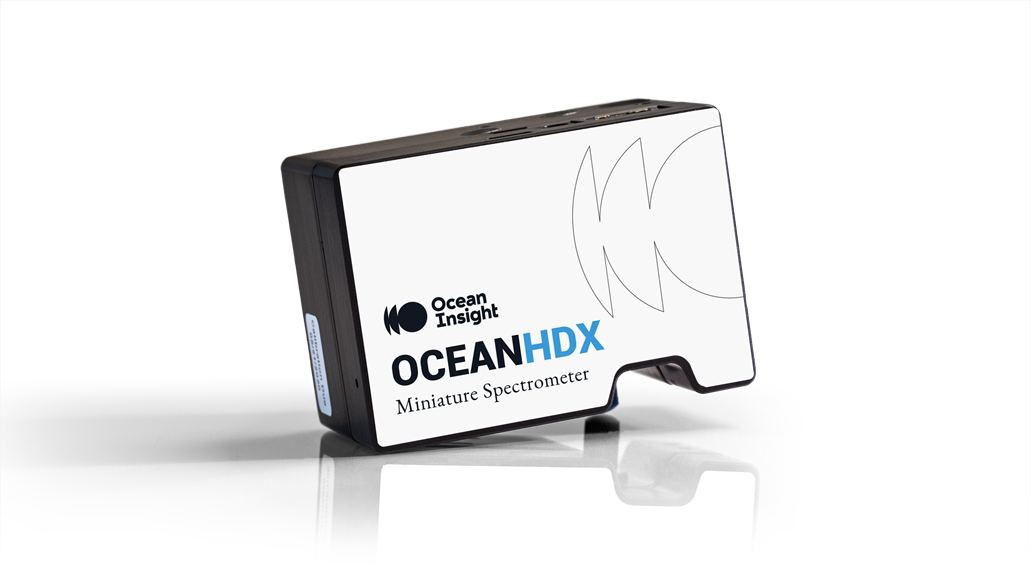
A modular setup for measuring LEDs comprises a spectrometer like our Flame, Ocean FX or Ocean HDX models, plus optical fibers and an integrating sphere to collect the output from the LED. Also, we can add an LED power supply/controller to operate the LED and adjust its drive current, and for absolute irradiance, include a radiometrically calibrated VIS-NIR source designed for use with an integrating sphere.

Absolute irradiance measurements require calibration using a source with known power output. A spectrum is measured with thesampling optic(cosine corrector, integrating sphere or optical fiber)connected tothecalibration light source, and is then compared to the known output power of the radiometrically calibrated light source. Here are someimportant tipsto remember for absolute irradiance measurements:
集合是a of the sampling optic is needed to calibrate a system radiometrically. There is a step in the OceanView Absolute Irradiance Wizard where this information is entered.


Here’s how to determine the collection area:
Preparing the best setup for absolute irradiance measurements
我们在我们的校准系统ISO/IEC 17025:2017-certifiedcalibration lab using a NIST-traceable light source for which irradiance as a function of distance is known.
This allows us to calibrate systems for a range of sampling optics, across different wavelength ranges, and at both high and low light intensities.
In this tutorial, we guide you through the steps to take when measuring the absolute irradiance of sources including lamps and LEDs. Learn how to calculate power output at each wavelength.
Options available
Preconfigured Ocean HDX Spectrometers
Prices From $6,714.00

Options available
Radiometrically Calibrated Light Sources
Prices From $1,537.00

Options available
Cosine Correctors
Prices From $65.00

Follow these steps how to set up the OceanView software to measure successfully your lamp or light source output power

Our world-class experts are available to help find answers to your toughest questions.